What ARE schools for?
Humans.

Luckily, my last three blogs have encapsulated my vision of what schools are for, so I’ll put them all together!
In a nutshell, schools are all about humans.
In my first blog I described how my ideas about what I was doing as a teacher evolved. Like this:
Idea #1: Teachers are like the elders sitting around the campfire, passing on their knowledge and wisdom to the young humans in their care.
Idea #2: I’m your tour guide! Come with me into the land that is ‘physics’ and let me show you around!
Idea #3: See it like I see it.
You see what I did? I thought I reframed the reason, but it’s essentially the same reason. It’s reason #1. Students are in school because from the age of 5 until the age of 18 we have the opportunity to be those elders passing on human culture by exploring the landscape and describing how we see it.

But, when there WAS a campfire (approximately 2 million years ago) until relatively recently (with the arrival of books in Western culture), what was passed on was an oral history. As a result, the knowledge that was passed on was relatively limited. Now? It is vast. And I can introduce them to only a tiny fraction of what we now know in physics. Luckily, they’ll have other teachers to do their bits as well. And of course, there are other adults and other sources outside school. Those sources may result in a rich diet of knowledge and culture, but could, equally, result in very little, or nothing at all. Schools are the opportunity to bring equity to what we, the elders, provide for all young humans.
Therefore, the point of schools is to widen the horizons of the young humans in our care (as equitably as possible), because the world is bigger than the campfire, and the possibilities are vast, encompassing arts, science, literature, history, sport, social sciences… and much, much more.
Blog 2: Why did I buy into tech?
… but I don’t buy into it now. And what does this have to do with the point of schools?
Firstly, the use of machines in schools comes at an opportunity cost for both teachers and students. If they, teacher or student, are using tech (whatever that is) by definition they are not doing something else. For example, the teacher is not guiding the student’s attention, responding to the room, shifting focus, elaborating on a point from personal experience and/or deep expert knowledge.
Secondly, machines haven’t come by their knowledge in the way that humans have come by theirs. They have no personal knowledge of the knowledge-building business. They didn’t build their own cognitive architecture, because they don’t have any. .
Finally, they don’t communicate knowledge to humans in the same way as humans do to other humans. On one level there is no non-verbal communication, but it is deeper than that. The human on the receiving end knows that at the other end is a machine. That makes for unavoidable limits to the interaction.
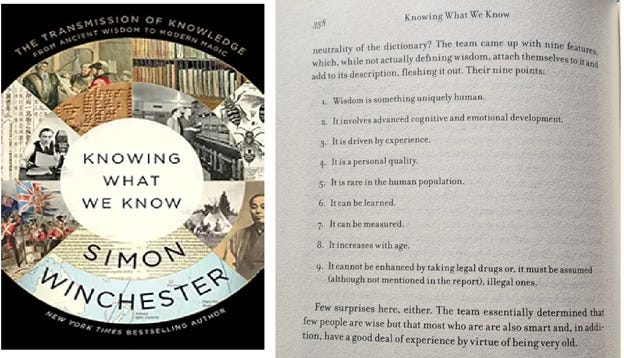
As I recently posted on X courtesy of Simon Winchester’s fabulous book, Knowing What We Know1:
“We may have a time where machines know more. We may even have a time when machines are (by some agreed definition) ‘intelligent’. But machines will never be wise.”
That’s why we need humans not machines to do the teaching. Humans with wisdom gained by their experience and expertise, through cognitive and emotional development.
Blog 3: Why DO they say it’s boring?
Brief summary: Adolescence is a time when there are ‘biologically primary’ drivers over which adults have no control. During the period from 12 years to 24 years old (approximately, could be longer), the brain is maturing, which involves a great deal of pruning of synapses (connections) and myelination (increasing thickness of insulation around nerve cells, speeding up signals). The reason for pruning/myelination, evolutionarily, was to produce a ‘fit’ brain that maximized the probability that the human would survive in their environment. To help facilitate aspects of that ‘fitness’, it is a time when dopamine has a significant effect promoting ‘useful’ behaviours. Those behaviours relate to extending their social network outside the family to encompass other humans who will help them survive. Finally, the last bit of the brain to mature is the pre-frontal cortex, the bit associated with executive control. So, that driving fast at 2 in the morning does seem like a good idea, with little in the brain to point out the potential problems. Find out more here.
In short, adolescence isn’t just raging hormones. It is a period biologically designed to make the brain of the young human fit for the purpose of living in the environment in which they find themselves. If you think about it that makes perfect sense.
And what is that environment? It is no longer just a world around a campfire. It is the whole world of human history, and the knowledge it encompasses, accessible because we (the elder humans) no longer have to remember it all. It’s written down.
This now poses some thorny questions that are worthy of discussion (but not here!).
How on earth do we (the adult humans/ teachers) decide what subset of all that knowledge to include?
What IS every young human entitled to irrespective of their location?
How much should be determined by their location?
Underpinning this is the question: what exactly does it mean to have a ‘fit’ brain now? Fit for what? We’re not talking about the knowledge needed to stay alive, find food, build a shelter (and if we are then we need to take care of those things first).
Ultimately, we mean ‘fit’ for the purpose of living a healthy, happy life with purpose and meaning. To make the most of, as Mary Oliver put it, ‘this wild and precious life2’. Which brings us to passions.
Young humans home in on their passion during adolescence, freed as they are from the need to acquire the skills needed to survive/thrive in their environment around the campfire. Passion for what?
We know that making connections with peers, pushing the boundaries… these things are biologically primary. They don’t need to be taught. Learning pretty much anything else in our vast human history and culture is biologically secondary. That’s what schools can provide: opportunities to learn things that they would not meet in the normal course of events, that take effort and guidance to learn about…because how do THEY know it’s not their passion if they haven’t seen it?
That’s what schools are for. Humans helping humans to see the range of possibilities stretching out ahead of them.
References:
1. Winchester S., (2023). Knowing what we know: the transmission of knowledge, from ancient wisdom to modern magic. New York: Harper.
2. Oliver, M. (1990). House of light. Beacon Press. Poem 133: The summer day.